
Last updated November 16, 2026
 Wrought iron
 Wood & steel frame
 Farm & ranch
 Sliding driveway gates
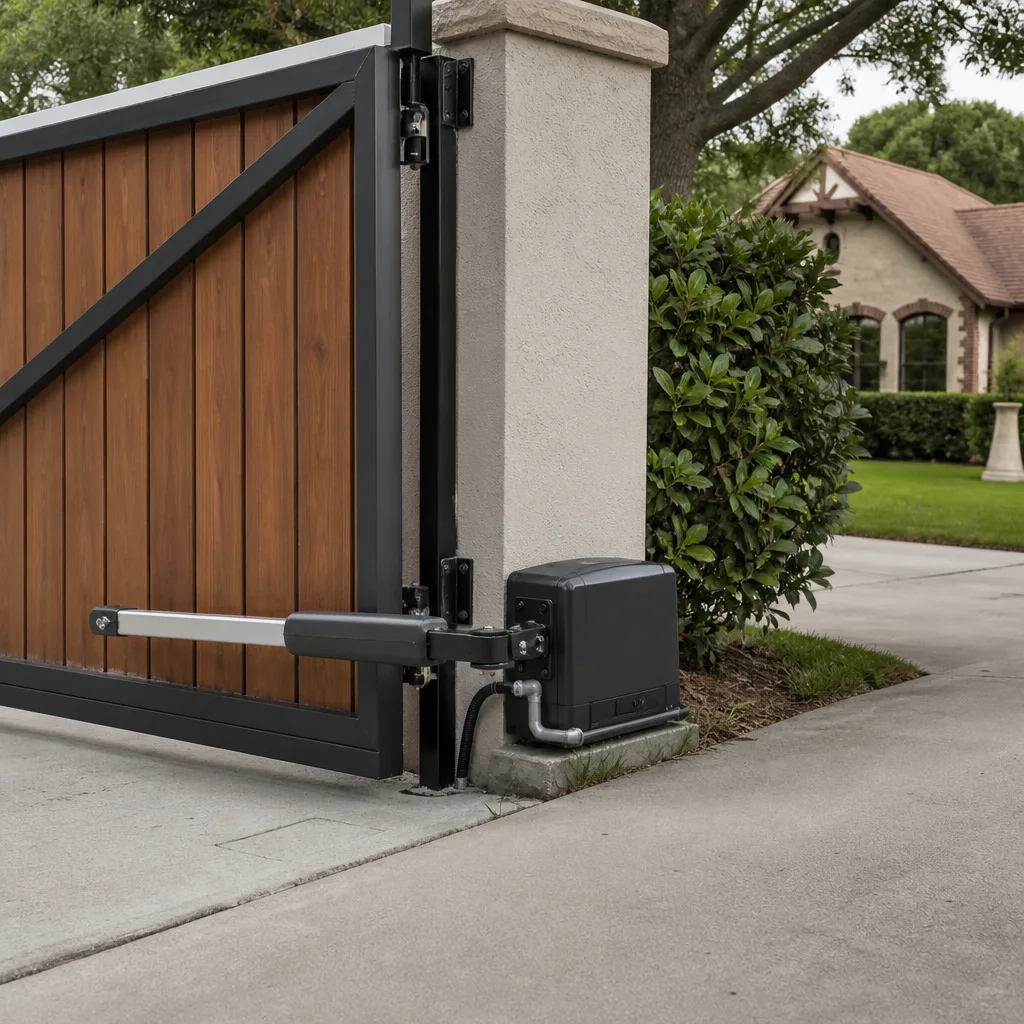 LiftMaster operators
Free on-site gate assessment - hinges, posts, and your LiftMaster or Nice gate operator checked before anything is quoted
The assessment is free and the quote is the invoice.
Get your free estimateGate Repair Maintenance Schedule: What to Do and When
The grease that protects your gate in July is the same grease that stiffens into resistance by February, and that resistance is what burns out motors. Most gate owners treat maintenance as a seasonal checkbox: spring tune-up, fall tune-up, done. That’s the wrong model. Gate components wear on entirely different timelines. A control board collects oxidation on its contacts while a hinge wears by degree, while a battery quietly drops capacity in summer humidity and gives no warning until the morning it can’t lift the arm. Treating all of them alike is exactly why operators fail early. This guide breaks the schedule down by component, cycle count, and Newark conditions. Gate Repair Newark handles gate repair, electric gate repair, and installation for residential and commercial properties.
Quick Answer
A proper gate repair maintenance schedule is built around three things: the number of cycles your gate runs per day, the calendar season you’re heading into, and the specific part being serviced. Residential gates (around 10 cycles daily) need lubrication, hinge inspection, and battery load testing roughly quarterly to twice a year, while commercial gates running heavy traffic need the same tasks on a shorter interval tied to cycle count. In Newark, the freeze-thaw cycle from late fall through early spring and the summer humidity both drive the schedule more than any holiday on the calendar.
Styles & brands we work with
- Wrought iron
- Wood & steel frame
- Farm & ranch
- Sliding driveway gates
- LiftMaster operators
Table of Contents
- Cycle-Based vs. Calendar-Based Maintenance
- Lubricants That Hold Up in Newark Winters
- Battery Backup Maintenance
- Hinge Wear on Sloped Driveways
- Control Board Contact Cleaning
- Operator Brands and Legacy Systems
- A Year in Gate Service: The Annual Rhythm
- Commercial Gate Scheduling
Cycle-Based vs. Calendar-Based Maintenance
A gate that runs 80 cycles a day wears out roughly eight times faster than a gate that runs 10, regardless of which month it is. That single fact should reshape how you think about maintenance. Cycle count, not the calendar, is the real clock on a gate operator. The calendar still matters, but only because weather accelerates certain kinds of wear on a predictable schedule.
An automatic gate “cycle” is one complete open and close. A driveway gate at a home might see 10 cycles on a busy day and 4 on a slow one. A commercial entrance at an apartment complex, a gated community, or a self-storage facility can easily run 60 to 80 cycles in a day, and much more during peak hours. The operators themselves are rated for a specific number of cycles, which is why commercial installers pay close attention to duty rating.
What this means in practice:
- Residential (low-cycle) gates: lubricate hinges and rollers on a quarterly schedule, load-test the battery twice a year, clean control board connections once a year, and inspect the entire system once at the leading edge of winter.
- Commercial (high-cycle) gates: the same tasks on monthly or bi-monthly intervals, with the control board check tied to every other lubrication service. Motor brushes, limit switches, and safety edges get inspected far more often.
- Seasonal weight on top of the cycle count: in Newark, add a full system inspection in October (before the freeze) and a spring check in March or April to catch what winter loosened.
This is the schedule a dedicated gate repair technician builds for you when they see the system, not a generic punch list mailed from a corporate office. The right answer depends on the gate in front of them.
Lubricants That Hold Up in Newark Winters
The wrong grease doesn’t just stop protecting your gate. It turns into drag. Chain lube, hinge grease, and roller lubricants that aren’t rated for cold climates congeal at low temperatures, which forces the motor to pull harder against its own hardware. That added load is one of the fastest ways to overheat an operator.
Newark’s winters regularly drop below freezing, and the freeze-thaw pattern means moisture works its way into joints through the day and freezes overnight. A lubricant that keeps its viscosity in that environment protects the surface through the cycle; a lubricant that stiffens at 32°F creates the resistance that burns out motors.
What to use, by part:
- Hinges and pivot points: a low-temperature lithium complex grease, not a thick wheel-bearing or chassis grease. Thin film, high resistance to washout, stable below freezing.
- Roller chains on slide gates: a dedicated chain lubricant that penetrates before it thickens, or a dry-film chain wax. Avoid heavy motor oil, which holds grit.
- Rollers and wheels: a light silicone or dry PTFE spray. Thick grease on a wheel that rolls contacts pavement dust and forms an abrasive paste.
- Operator drive arm and gearbox: use only the manufacturer-specified lubricant. Many sealed operators require none at all after installation, and adding grease can do damage.
- What to avoid: WD-40 as a lubricant (it’s a solvent/water displacer, not a long-term grease), cooking spray, and general-purpose automotive grease in cold weather.
Lubrication schedule: every 3 months for residential gates and every month for commercial. In Newark specifically, do one pass in late October with cold-rated product and another in March to clear what winter left behind. If your gate is doing more than 30 cycles a day, shorten the intervals to every two weeks.
Battery Backup Maintenance
Lead-acid batteries in gate operators fail up to 18 months before their rated lifespan without regular testing, especially in Newark’s humid summers. Heat is the silent killer, not cold. A battery that lives its life inside a metal enclosure through 90°F days degrades from the inside out, and the operator gives no warning until it can’t lift the gate during an outage.
This matters more than most owners realize, because in a power failure the battery IS the operator. If it’s already near the end of its capacity, the gate is stuck open or stuck closed when you need it most. The good news is that load testing catches this long before failure.
A proper quarterly battery check looks like this:
- Visual inspection: look for swelling, casing distortion, corrosion at the terminals, and any crusting around the leads.
- Terminal cleaning: disconnect power, brush terminals clean, and treat with a battery terminal protector.
- Voltage reading: a healthy 12V or 24V battery reads at or above its rated voltage at rest. Confirm against the operator specs.
- Load test: run the gate one full cycle on battery power alone (with the main power disconnected) and watch for sluggishness, slowed travel, or stalling. This is the fastest read on true capacity.
- Recharge test: reconnect power and confirm the battery recharges within the operator’s normal window.
- Replacement trigger: any battery showing swelling, slow travel under load, or failing a load test should be replaced immediately, not nursed through another season.
For Newark homes and businesses, we recommend quarterly load testing from June through September (humid months) and a full inspection in November before winter. That catches the summer degradation before cold weather puts load on the operator.
Hinge Wear on Sloped Driveways
Swing gates on sloped driveways wear hinges much faster than gates on level ground, and the wear pattern is predictable: the downhill-side hinge takes the load as the gate sags, the gate starts to drag, and the operator arm has to push harder to compensate. Left unaddressed, this wear chain ends at a stripped operator arm, an overheated motor, or a bent hinge post.
Newark’s older residential neighborhoods are full of driveways with some slope, from the Ironbound to parts of Weequahic and the West Ward. That geometry is one of the most common hidden causes of operator failures we diagnose. The gate isn’t broken; the operator is being asked to do work that its hinge hardware was supposed to carry.
What to check every quarter:
- Plumb and level: with the gate closed, look for sag at the latch end. A gate that hangs unevenly by more than a small amount is loading the operator.
- Hinge bolt torque: check each hinge for looseness. Bolts that vibrate loose are usually the first sign of a slope problem.
- Hinge pin wear: look for grooves, wobble, or dark wear marks at the pin. A worn pin should be replaced, not tightened further.
- Gate-to-post gap: measure the gap at the top and bottom of the hinge side. A gap that changes between closed and open travel means the hinge is moving under load.
- Operator arm angle: the arm should sit at the manufacturer’s specified angle with the gate closed. If it’s binding at the top of travel, the hinge issue is already affecting the operator.
If your gate swings on a slope, budget for hinge inspection every quarter, not once a year. Repairing a hinge costs a fraction of replacing an operator arm, and the operator is what fails first if you ignore the hinges.
Control Board Contact Cleaning
Most intermittent gate faults in systems over five years old come back to oxidized or contaminated control board contacts. The gate works fine one morning and refuses to open the next, then works again the day after. That cycle of intermittent failure is almost never the motor. It’s almost always the board.
Control boards are the operator’s brain, and their low-voltage connections are the part that suffers most from environmental exposure. Newark’s humidity, road dust from nearby streets, and pollen through spring all build up on the terminals. Every contact that isn’t clean is a point of resistance, and resistance makes sensors misfire, limits trip early, and safety edges behave inconsistently.
A proper annual control board service covers:
- Power down and lock out the operator. No exceptions.
- Visual inspection of every terminal block for darkening, crusting, and green or white deposits.
- Contact cleaning with an electronics-safe contact cleaner and a soft brush. Never use abrasives on the board.
- Reseat every low-voltage cable at the board, the sensor, loop detector, and safety edge.
- Check for moisture ingress at the enclosure gasket and look for signs of water tracking onto the board. Newark summer thunderstorms find their way into any enclosure that has lost its seal.
- Test every input and output after cleaning: open command, safety reverse, loop detector, and any access control connection.
Brand matters less than condition here. A Linear, Viking, Ghost Controls, or DoorKing board all have the same weak point: low-voltage connections that don’t get inspected unless someone opens the enclosure. That annual contact cleaning is one of the highest-value things you can do for a legacy operator.
Operator Brands and Legacy Systems
Maintenance schedules go wrong when they assume every operator is built the same. A LiftMaster residential unit, a DoorKing commercial operator, a FAAC swing gate arm, a BFT sliding system, a Linear and a Viking, an Elite and a Mighty Mule, and a Ghost Controls DIY-friendly unit all differ in how they handle lubrication, battery testing, and control board service. Getting a maintenance plan right means matching the plan to the equipment on the gate.
That’s why we work on the brand you already have. If an operator is older, mixed-brand, or non-standard, it still has a right maintenance schedule. Older units need more frequent contact cleaning, closer battery attention, and more careful hinge inspection because they tend to be running well past the original design expectation. A DoorKing commercial operator at a big Newark property might need driver motor brushes checked at 300,000 cycles. A Ghost Controls residential operator on a quiet driveway might not need that service at all.
Our technicians have up to 10 years of experience across nine brands, and we troubleshoot the system in front of us rather than fitting it into a brand-specific playbook. That’s especially relevant for owners whose gate has been serviced by multiple companies over the years, with mixed parts, non-standard wiring, or aftermarket controls that don’t match the original manual. We handle diagnosis, repair, and new installation in one service call, so a schedule doesn’t get stuck waiting for another contractor.
A Year in Gate Service: The Annual Rhythm
Cycle count drives most of the schedule, but the Newark calendar adds a second track that almost every owner can use as a reminder. Here’s how a residential maintenance schedule maps to a year in Newark:
- March / early April: post-winter inspection. Flex test hinges, check for freeze damage, inspect the operator arm and limit switches, and clear salt and grit from the gate track.
- May: first lubrication of the season with warm-weather product, plus a control board contact check ahead of summer storm season.
- June – September: quarterly battery load tests. Humidity is the enemy of lead-acid in Newark; don’t skip this window.
- Late October: full pre-winter inspection. Lubricate every hinge and roller with cold-rated product, check the enclosure seal for gaps, confirm operator arm angle and hinge torque, and verify the battery will survive a winter outage.
- December – February: avoid greasing with cold-weather-sensitive product. Confirm the operator is running freely; resistance in winter is where summer lubrication debt gets paid.
- Any month: annual control board contact cleaning, plus a full diagnostic if you notice new sounds, slower travel, or intermittent sensor behavior.
This is the shape of a maintenance plan, not a strict rule. Adjust by at least one step for high-cycle gates and tighten intervals if you’re seeing problems in any season.
Commercial Gate Scheduling
If a gate serves more than about 30 cycles a day, its maintenance schedule belongs on a cycle counter rather than a calendar. Commercial gate systems at apartment complexes, gated communities, self-storage facilities, and parking entrances need to be serviced by the number of cycles they’ve actually run, not by the month. A DoorKing operator at a busy Newark entrance might run 80 cycles every weekday, while the same model at a low-traffic lot might run 15. The service interval should reflect that gap.
A high-cycle maintenance schedule looks like this:
- Monthly: lubrication on every hinge, roller, and chain; visual inspection of the operator; safety edge and loop detector test.
- Every 2-3 months: battery load test and control board contact cleaning.
- Every 6 months: hinge pin inspection for wear, operator arm torque check, limit switch confirmation.
- Annually: full diagnostic, motor brush check where applicable, and a written condition report that flags upcoming replacements before they fail.
For commercial properties, a documented maintenance log matters as much as the work itself. It tells you what was checked, when, and by whom. We recommend the log live in the operator enclosure or a property maintenance file so the next service visit has a baseline.
Common Mistakes to Avoid
- Treating maintenance as a once-a-year event. One annual visit can’t catch battery degradation, hinge wear, and control board oxidation on the same day, because they don’t happen on the same schedule. The annual visit is a baseline, not a plan.
- Using the wrong grease in winter. Cold-thickening lubricant adds drag the operator has to overcome, which is exactly what you’re trying to prevent. Use a product rated for low temperatures, and switch products for the cold months in Newark.
- Skipping battery load testing through summer. A battery that tests fine at rest can still fail under load. The only test that catches a weak battery in Newark humidity is a full cycle on battery power alone.
- Ignoring hinge sag on sloped driveways. A sagging hinge transfers load to the operator arm, which then fails. Fix the hinge; don’t upgrade the motor to compensate.
- Never cleaning the control board. Intermittent faults get misdiagnosed as broken sensors or failing motors when the actual problem is a dirty contact. Cleaning is a 20-minute task that prevents a lot of unnecessary parts replacement.
- Assuming brand dictates maintenance. A Linear and a DoorKing across the street from each other can need very different schedules. The gate and its cycles drive the plan, not the nameplate.
- Letting maintenance lapse until an electric gate repair becomes urgent. A jammed arm, sensor, or control board gets more expensive the longer the underlying wear has been building. Catching it on a schedule is always cheaper than catching it as a failure.
See the difference
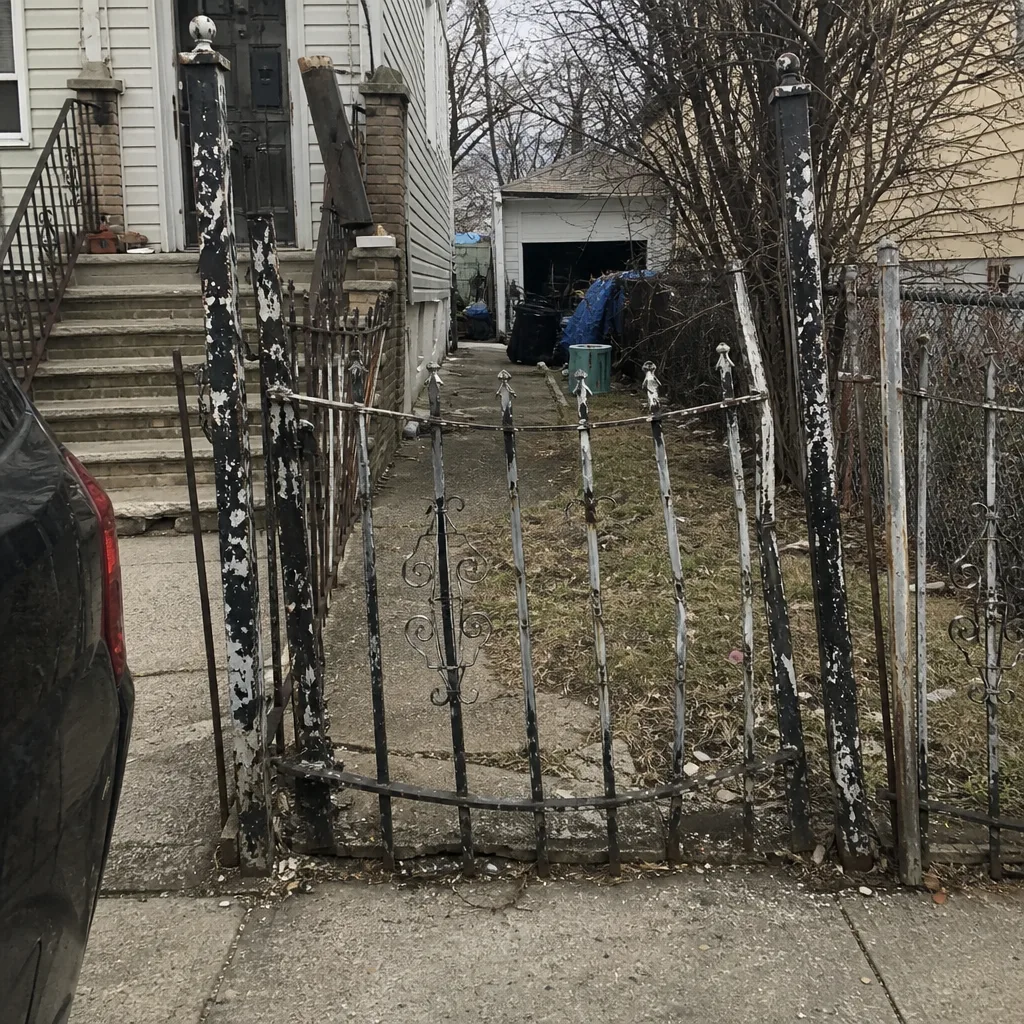 Before
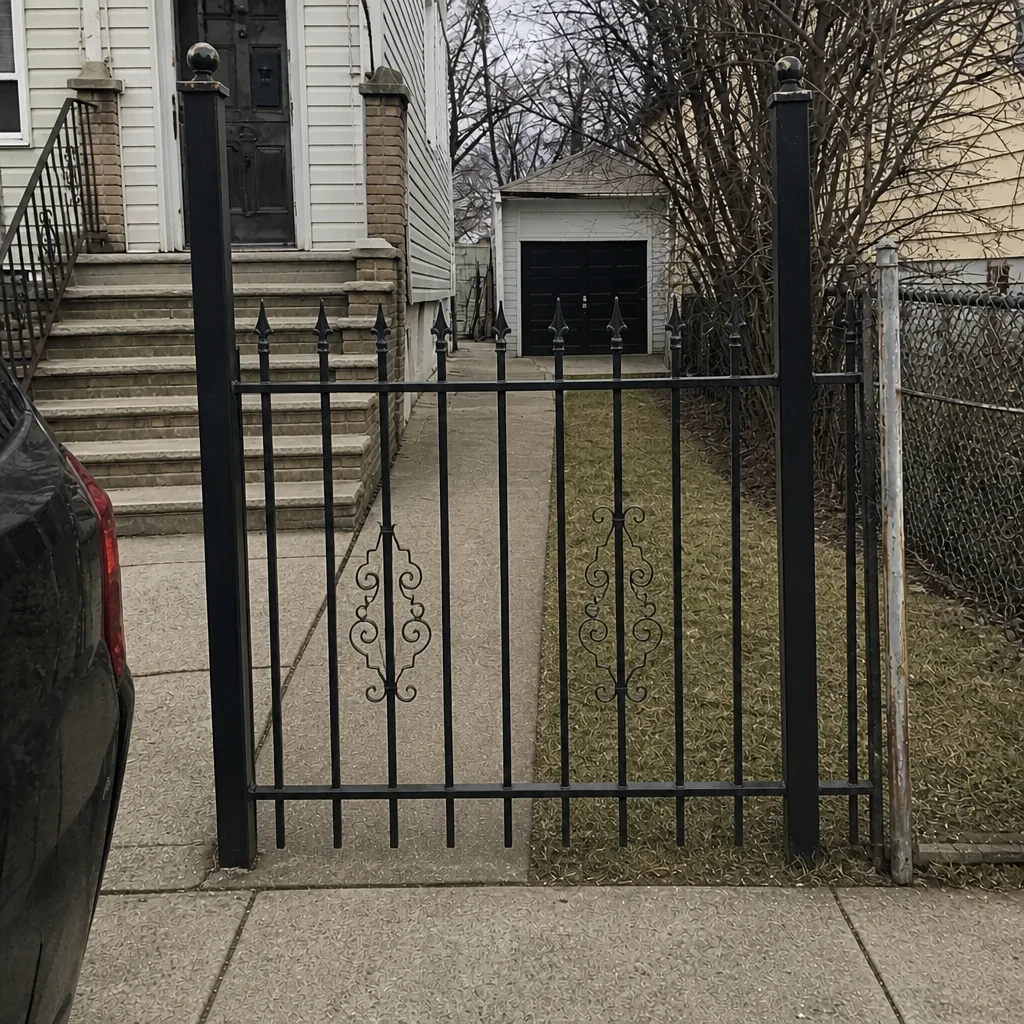 After
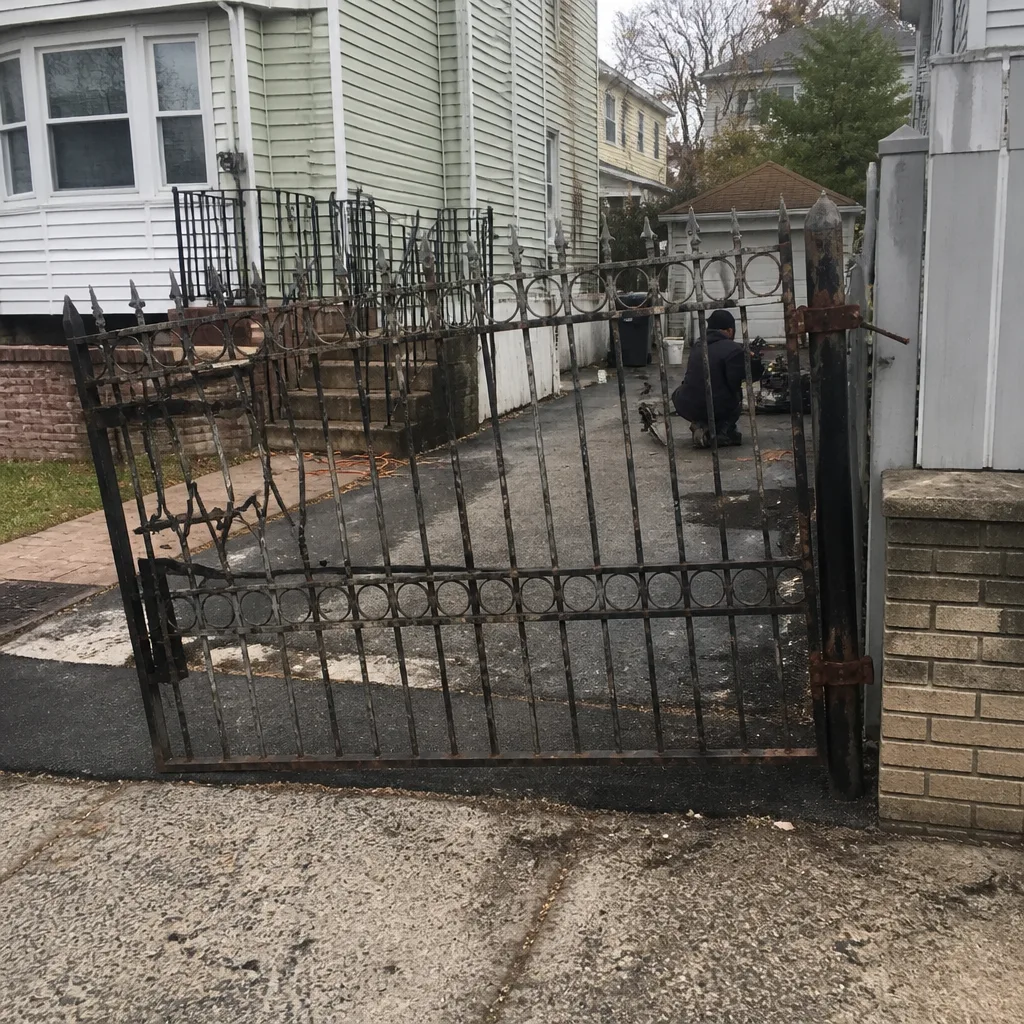 Before
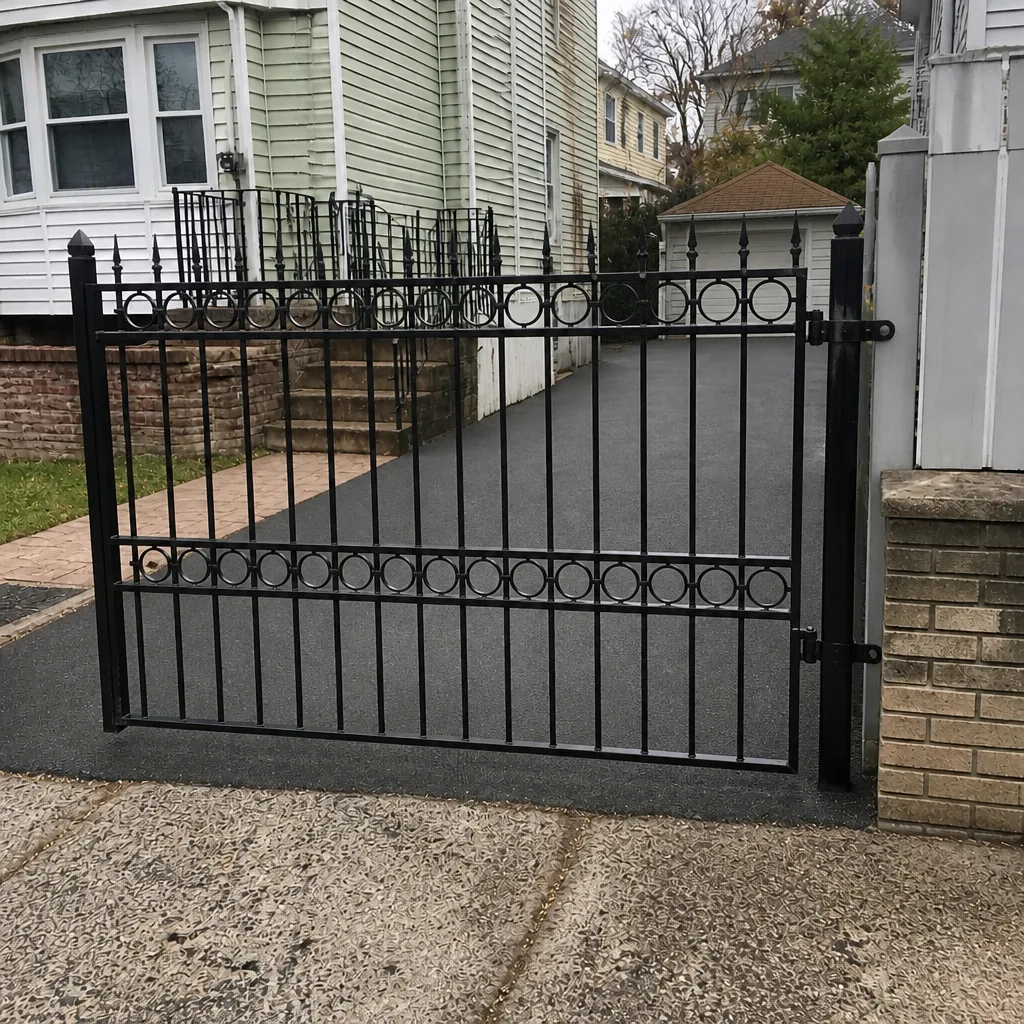 After
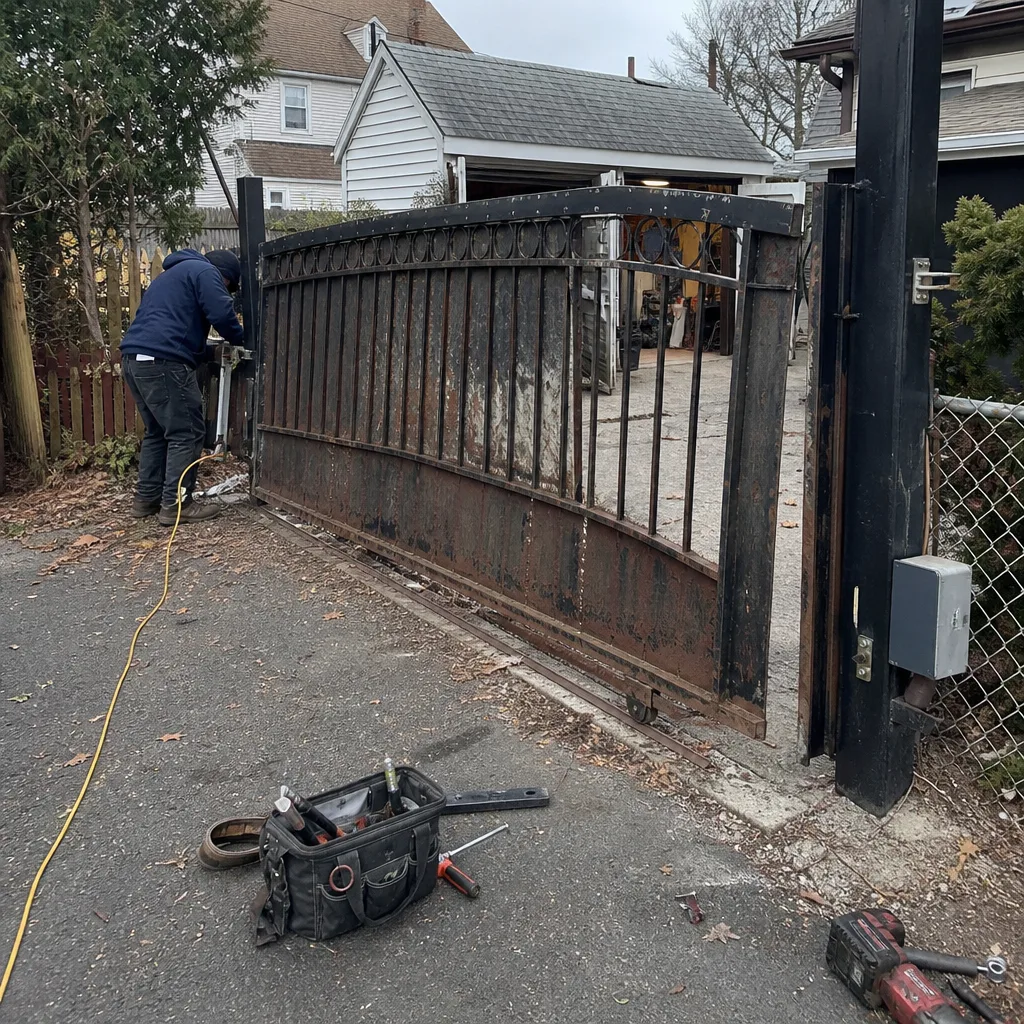 Before
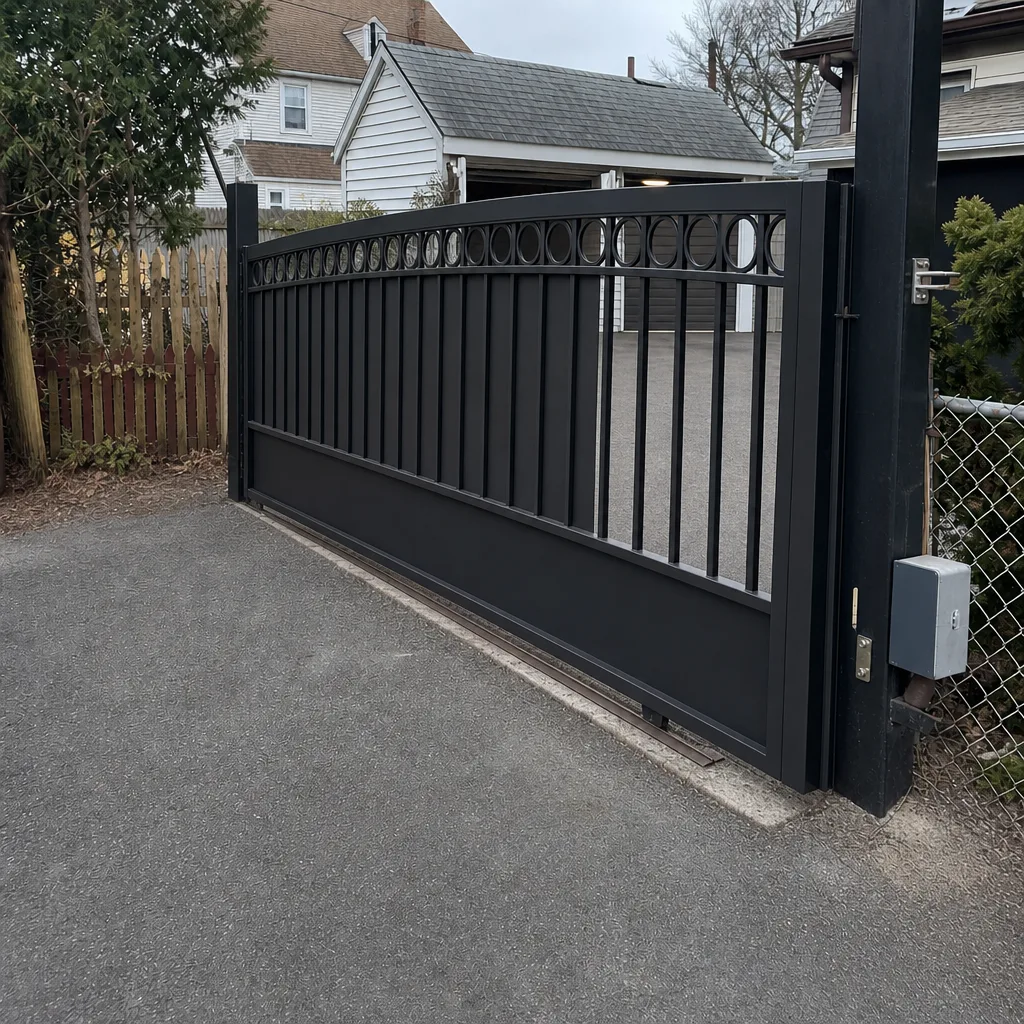 After
When to Call a Professional
Some maintenance is safe to do yourself: visual inspection, cleaning the gate track of debris, and wiping down the outside of the operator housing. Others should be handled by a trained technician, and this is where we recommend calling rather than reaching for a wrench.
A few specific triggers warrant a professional visit:
- The gate reverses unexpectedly at random, or an open or close command intermittently fails.
- The operator runs but the gate doesn’t move, or moves unevenly.
- You see swelling or corrosion at the battery, or the gate can’t open on battery power during an outage.
- Your hinges show sag, bolts vibrate loose, or the operator arm binds at any point in the travel.
- You’re dealing with damaged wiring, an operator that won’t power on, or a safety sensor that keeps misfiring after a reset.
Most gate problems are diagnosable on the first visit, and electric gate repair on control boards, sensors, loop detectors, and motor assemblies is our core work, not a side service. Gate Repair Newark offers free estimates in Newark.
Frequently Asked Questions
Residential gates in Newark should be serviced every 3 months for lubrication and hinge checks, with a battery load test twice a year and an annual control board cleaning. Commercial gates above about 30 cycles a day should be serviced monthly on the high-cycle items. The exact schedule depends on cycle count, gate type, and operator brand.
Yes. Winter is when cold-thickening lubricant and freeze-thaw moisture put the most stress on moving parts, and a gate that’s running fine in November may be quietly loading the operator. A late-October lubrication pass with cold-rated product and a hinge inspection is worth doing even if the gate seems fine.
A low-temperature lithium complex grease for hinges and pivots, a dedicated chain lubricant or dry-film wax for roller chains, and a silicone or dry PTFE spray for rollers and wheels. Use only manufacturer-specified lubricant on a sealed operator drive, and avoid general automotive grease, thick chassis grease, and WD-40 as longer-term protection in cold weather.
Any battery showing swelling, crusting at the terminals, slow gate travel on battery power alone, or failure to complete a full cycle under load should be replaced. In Newark’s humid climate, we recommend a quarterly load test from June to September, since heat and humidity degrade lead-acid batteries faster than their rated lifespan suggests.
Intermittent open failures are usually a control board contact problem, not a motor failure. Oxidized or contaminated low-voltage connections cause sensors, limits, and safety edges to misfire unpredictably. Contact cleaning and reseating the connections fix the majority of these issues on operators over five years old.
Yes. We service residential swing and slide gates and commercial gate systems throughout Newark, and we handle brands including LiftMaster, FAAC, BFT, Linear, Viking, Ghost Controls, DoorKing, Elite, and Mighty Mule. We also work on legacy operators, mixed-brand setups, and non-standard systems other providers turn away.
The Bottom Line
Gate maintenance isn’t one schedule. It’s three that run in parallel: a cycle-count schedule that tracks how much work the operator is actually doing, a seasonal schedule that matches the lubrication and battery tasks to Newark’s freeze-thaw winters and humid summers, and a component schedule that gives hinges, batteries, and control boards service on the timelines they each actually need.
Get those three in line, and the operator stops failing prematurely. Keep an eye on hinge wear on sloped driveways, use cold-rated lubricants in winter, load-test the battery through the summer, and clean the control board contacts once a year. If your gate is showing any of the warning signs above, call (833) 983-2324. We answer 24/7. Fast dispatch from 7am to 7pm, Sunday through Friday. From Newark to a jammed arm to a full installation, we service the gate you already have.
Written by the team at Gate Repair Newark.